Vibration Monitoring Systems
Vibration monitoring systems are essential in proper predictive maintenance. They can help prevent expensive and highly inconvenient machine breakdowns and work stoppages. These systems work by continually monitoring the vibration from machinery and machine parts and sending out alerts when any anomaly is detected.
Early detection of these anomalies means that corrective action can be taken on time. Such corrective action can include the following:
- Repairs of faulty machinery or components
- Replacement of components
- Scheduled downtime to allow machines to recover or rest
In short, vibration monitoring systems can help save time, money, and the lifespan of assets by allowing you and your maintenance team to conduct proper machine health monitoring. Vibration monitoring systems are useful for a range of applications. Here are just a few of the most common industrial uses:
- Rotating Machinery
- Bearings and Gears
- Reciprocating Compressors, Engines, and Pumps
- Bridges
- Pipes
It is especially common in rotating machinery or parts since rotating motion means that machine parts are liable to wear and tear. In this article, we take a brief look at how vibration monitoring systems work and the options available at G-TECH Instruments Inc., such as the VT-3510 and VimoNet X4 .
How Do Vibration Monitoring Systems Work?
Vibration monitoring systems work by relying on vibration trend analysis. Vibrations can be thought of as the pulse of your machines. In the same way that a doctor can measure a human pulse to determine the health of your body, vibrations can be used to determine the health of a machine or the components in a machine.
In vibration trend analysis, the key is to find irregularities in the vibration signals emitted from a machine or equipment. These irregularities are defined by what is called the baseline vibration trend, which is vibration signatures that are established when your machine is in optimal health or optimal performance.
If you experience a situation where vibration amplitude wildly fluctuates, this means that there may be an issue in your machinery. Vibration systems work by converting vibration signals into an overall amplitude value. This overall amplitude includes several parameters from various rotating machine components. More sophisticated systems can even include recordings of vibration waveforms.
G-TECH's Vibration Monitoring Systems
G-TECH has a range of vibration monitoring systems that can help you effectively monitor the health of your machinery. Let's begin with the VT-3510. This is a system that can directly convert vibration signals from accelerometers into a 4-20mA current signal and transmit it to the back-end DCS or PLC system to monitor vibration values. It works for equipment and machines that are in continual operation, such as:
- Motors
- Windmills
- Cooling towers
- Compressors, and
- Gearboxes.
This is a simple, effective, and cost-effective way to monitor the vibration value of existing equipment. The VT-3510 has a DIN rail backplane for installation in explosion-proof enclosures and a raw voltage output terminal for data collector and spectrometer analysis.
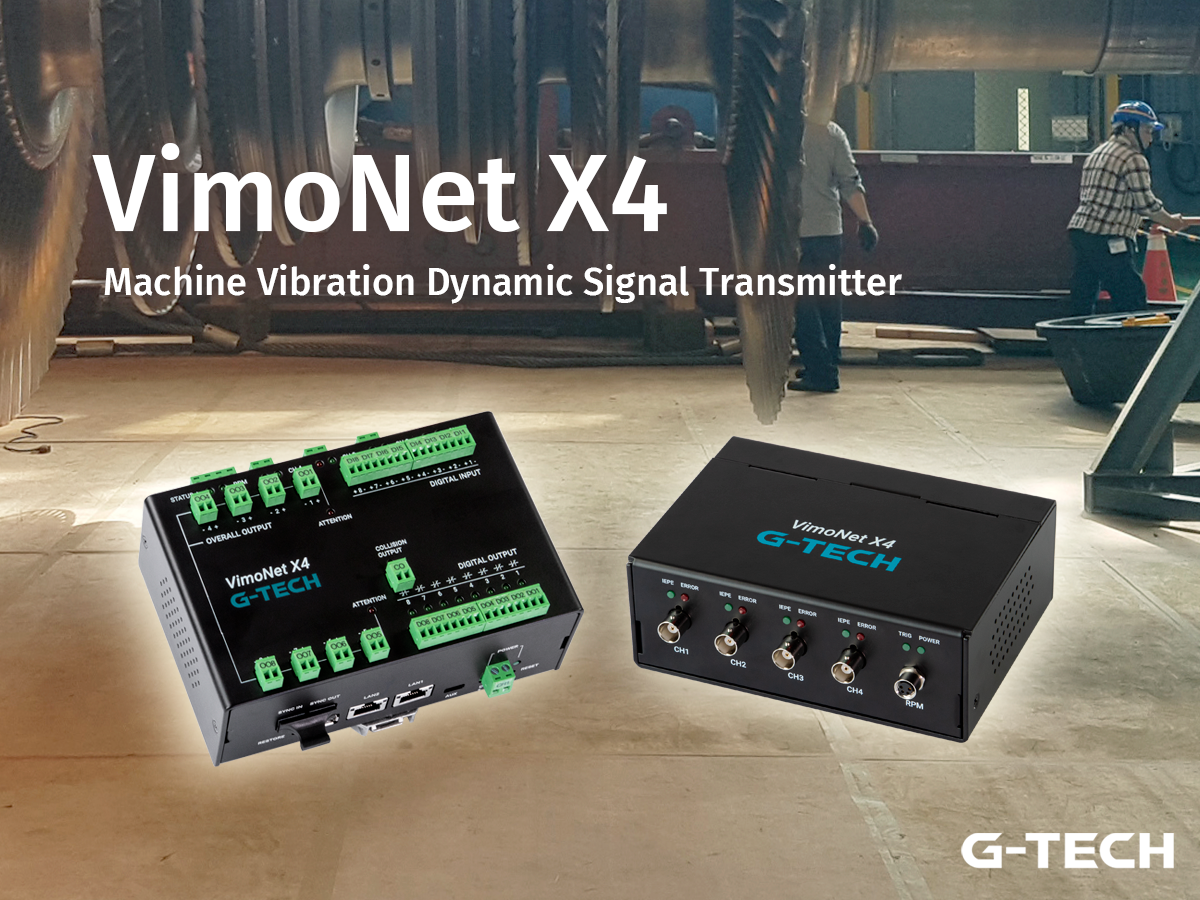
VimoNet X4
VimoNet X4 is a 4-channel simultaneous measurement online monitoring module that supports both voltage-type and IEPE-type sensors. It's a vibration monitoring system that can be deployed in two ways. First, it can be used as a modern monitoring network system through an Ethernet network connection. Second, it can operate independently for continuous monitoring without needing a network connection. The system can be used in the following areas:
- Vibration online monitoring
- Machine crash prevention
- Slope and landslide monitoring
The VimoNet X4 is powerful enough to be used in various monitoring systems because it has a built-in high-speed DSP computing chip. In addition to this, it has network connectivity, digital I/O, an analog output interface, and a relay output function, which can be integrated with external peripherals to realize intelligent production and manufacturing. It also boasts of intuitive utility software that allows you to quickly and easily configure VimoNet X4 functions. To learn more, please check out the product page .
Vibration/Temperature Dual Output Sensor: Wilcoxon
G-TECH is also an official vendor for Wilcoxon Research dual-output sensors. These are sensors that have the ability to measure both vibration and temperature values in one installation. It includes two types of sensors — upright and lateral. They also come with an explosion-proof design, as well as high-quality and low-frequency model variations .