Signal Transmitters: Everything You Should Know
Signal transmitters are devices used in industrial instrumentation to convert measurements from sensors into standardized electrical signals that can be easily transmitted, monitored, and analyzed. These devices act as the bridge between physical processes and digital control systems.
In most industrial environments, sensors measure variables such as temperature, pressure, vibration, flow, or liquid level. However, the raw signals generated by these sensors are often weak or incompatible with monitoring systems. Signal transmitters solve this problem by conditioning the sensor output and converting it into a standard signal format, which is commonly a 4–20 mA current signal.
For example, a temperature sensor might detect a change in heat and produce a small electrical signal. A transmitter then converts that signal into a proportional current output that can be sent over long distances to a programmable logic controller (PLC), distributed control system (DCS), or data acquisition platform.
Signal transmitters are widely used across industries, including manufacturing, energy production, chemical processing, water treatment, and machine condition monitoring. Their standardized outputs allow operators to monitor process conditions in real time and automate responses to changes in equipment or environmental conditions.
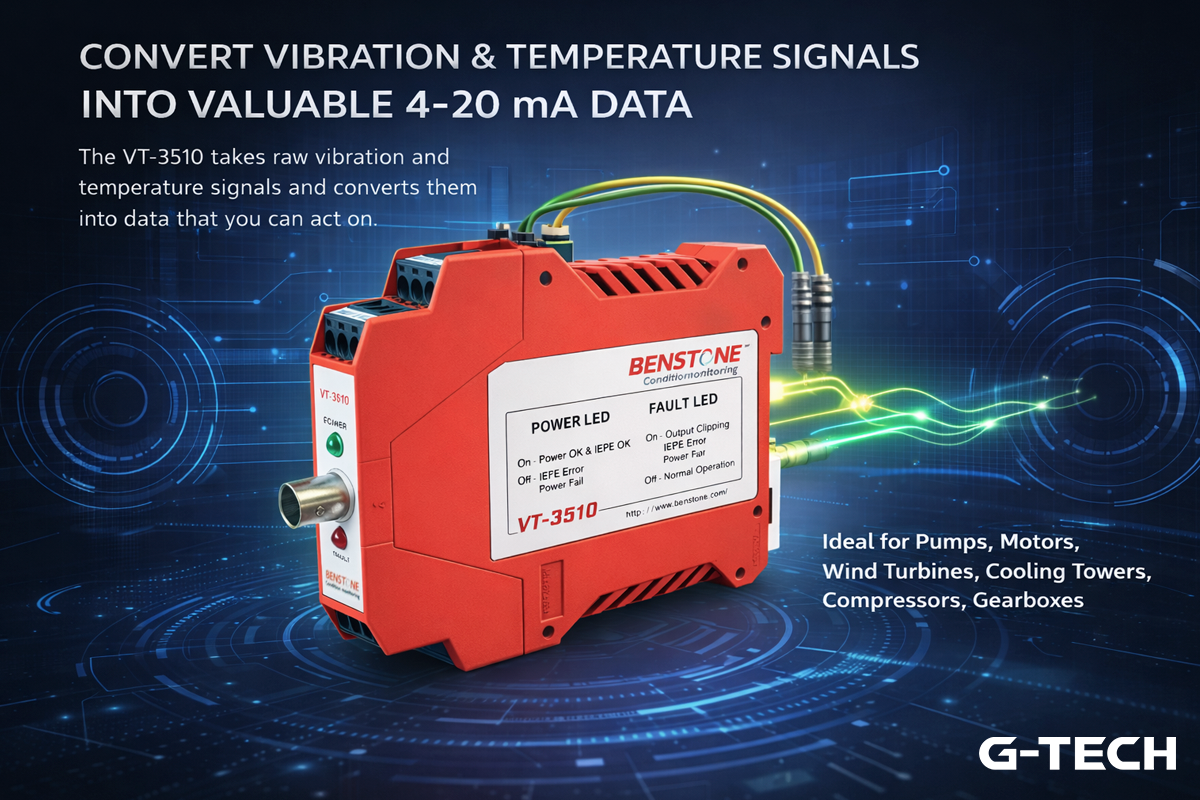
G-TECH's VT-3510 signal transmitter
How Signal Transmitters Work
The operating principle of a signal transmitter involves three key stages: measurement, signal conditioning, and transmission.
1. Measurement
The process begins with a sensing element that detects a physical variable such as temperature, vibration, pressure, or flow. The sensor converts the measured parameter into a small electrical signal.
2. Signal Conditioning
The transmitter electronics then process this raw signal. This stage may include filtering, amplification, linearization, and temperature compensation to ensure accurate measurements. Modern transmitters often incorporate microprocessors to perform diagnostics and advanced calculations before generating the output signal.
3. Signal Transmission
Once conditioned, the signal is converted into a standardized output—typically the 4–20 mA current loop used throughout industrial automation. In this system, 4 mA represents the minimum value of the measurement range, while 20 mA represents the maximum.
This current-loop design offers several advantages:
- Noise resistance: Current signals are less susceptible to electrical interference in industrial environments.
- Long-distance transmission: The signal can travel long cable distances without degradation.
- Fault detection: A reading below 4 mA can indicate wiring faults or equipment failures.
Many transmitters operate using a two-wire configuration, where the same pair of wires carries both the power supply and the measurement signal. This simplifies installation and reduces wiring complexity in industrial facilities.
Signal Transmitters at G-TECH
At G-TECH, we manufacture a number of signal transmitters, such as the VT-3510 Vibration Signal Transmitter and the VimoNet X1, which can help you deliver effective machine health monitoring systems. These transmitters capture signals from sensors that monitor parameters such as vibration, speed, or temperature, and convert them into standardized outputs for analysis.
Integrated with monitoring platforms, these transmitters allow operators to detect abnormal conditions early and take preventive action before equipment failures occur. By delivering reliable and accurate signal transmission, they enable real-time diagnostics, data visualization, and predictive maintenance strategies.
G-TECH’s signal transmitter technology is designed to integrate seamlessly with machine protection and condition monitoring systems, helping industrial facilities maintain operational stability and minimize unexpected downtime. To learn more about our signal transmitters, please check out our product page.