Industrial Sensors: Guidelines & Recommendations
Industrial Sensors: Guidelines & Recommendations
G-TECH designs and manufactures advanced industrial sensors for a range of industrial operations. Our company strongly believes in Industry 4.0 principles and IoT, and both the sensors we design in our labs and the sensors we distribute on behalf of our partners reflect this commitment.
The quality and performance of a modern industrial sensor are largely determined by how well it captures and transmits vast amounts of complicated and sensitive data. The automated and SCADA-based systems that modern industry relies on require analog data from machines and components to be quickly converted into digital signals in real-time. This data also needs to be visualized through human-machine interface (or HMI) systems.
Industrial sensors are required for both routine modern automated processes and predictive maintenance systems that monitor the health of these industrial operations. At G-TECH, we produce both advanced sensors, such as the DS-R35, and advanced monitoring systems, such as the VimoNet X4, that process signals from these sensors.
What Is an Industrial Sensor?
Sensors are specialized devices designed to detect and measure changes in the environment or a machine. The parameters measured by a sensor vary and may cover distance, vibration, temperature, light, fluid flow, and so on.
Once these signals are detected, they are then transformed into electrical signals that are then used by control systems such as PLCs and computers to monitor conditions or trigger responses in a process. Sensors are the eyes and ears of modern industrial processes and systems and provide real-time data required for the proper functioning of automated systems.
They serve various functions in:
- Process control
- Safety systems, and
- Quality assurance
- Predictive Maintenance
For process control, sensors are required to ensure that industrial processes don’t step beyond set parameters. For example, making sure that a furnace doesn’t burn beyond a certain temperature. For safety systems, it means detecting when conditions are unsafe and triggering alerts or system shutdowns. For example, smoke sensors can detect when a room has too much smoke, triggering an alarm to prevent accidental fires.
In the field of quality assurance, sensors monitor standards to ensure products meet specified quality standards. For example, vision sensors can classify fruits by quality by detecting defects in their appearance. Predictive maintenance is what we are concerned with at G-TECH. Sensors in predictive maintenance measure signals such as vibration, temperature, or pressure to monitor the health of machines or machine components. These signals are then read to determine if machines or machine parts need to be repaired or replaced, and are useful in preventing unplanned machine failures or shutdowns.
In short, sensors are critical in modern industrial processes and systems. They allow machine-to-machine communication, improve efficiency and precision, and enhance safety. Sensors can be seen as the basis of automation and Industrial IoT in modern industry.
The Different Types of Industrial Sensors
There is a sensor for just about every stimulus that you can think of. The table below provides a list of the most common sensors used in modern industries:
|
Definition of Sensor |
Application |
|
Detects an object’s presence or nearness without direct contact. |
|
|
Uses a light beam (usually laser or LED) technology to detect objects or changes |
|
|
Measures and converts the force exerted by liquids or gases into readable electronic signals. |
|
|
Monitors and measures temperature levels in machines or immediate environments. |
|
|
Measures distance and detects the presence of objects by emitting high-frequency sound waves |
|
|
Captures images of products/objects to monitor for defects |
|
G-TECH's Industrial Sensors
G-TECH’s predictive maintenance systems and devices rely on advanced sensor technology. We not only design advanced industrial sensors, such as the DSR-35 vibration sensor, but we also design the systems that are required to capture and convert the signals detected by these sensors.
This means that we rely heavily on advanced digital signal processing (or DSP) technology, which can capture vast amounts of complicated data and transform it into signals that can be visualized and read by human-machine interface systems. The sensors we design are tough, innovative, and can operate under the harshest and most dynamic industrial environments while providing accurate and high-performance. The two sensors we will look at are the DSR-35 wireless vibration sensor and the vPod Pro’s A52–IR
1. DSR–35 Vibration Sensor
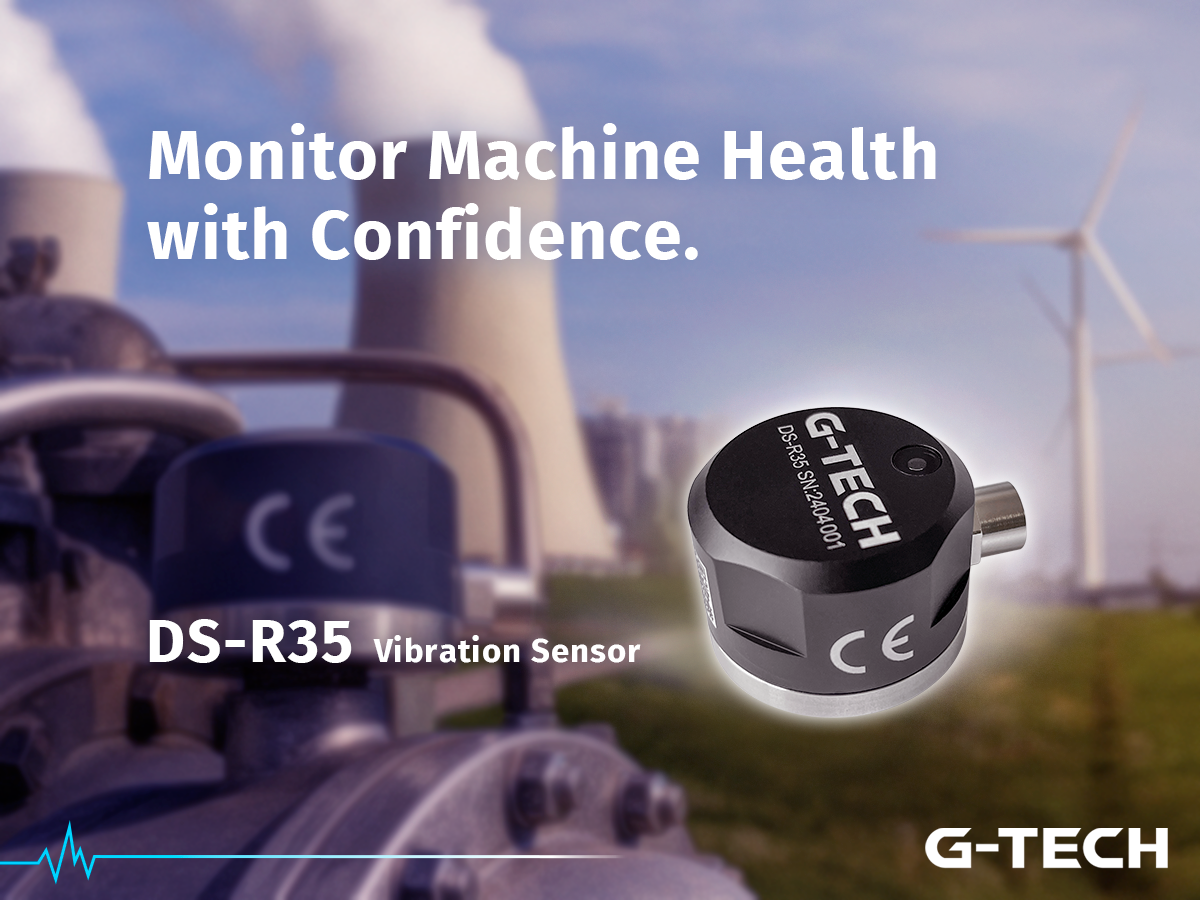
The DSR–35 is G-TECH’s industrial sensor that blends toughness with cutting-edge precision, and it does so in style. This sensor enables you to accurately monitor machine health under the most dynamic and difficult industrial and operational conditions.
It's tough and reliable. With its IP67 rating, it was built for the harshest industrial environments. It also has an up to 5kHz high frequency response. This sensor is ideal for vibration monitoring in the following areas:
- General machine health
- Wind turbines
- Equipment in the energy industry
- Industrial automation processes
- Robotic and automation equipment
- Rail transport
With G-TECH’s DS-R35, you get a vibration sensor that can help you avoid surprises in your operations and that can take you one step closer to achieving ZERO downtime in your operations. To learn more, check out the catalog on our product page.
2. The vPod Pro Sensor: A52–IR
The A52-IR is an innovative sensor that is used in G-TECH’s vPod Pro. This finely tuned and sleekly designed device comes with the following features:
- A high-strength magnetic base.
- An infrared thermometer.
- An IEPE accelerometer.
This allows the vPod Pro to measure vibration signals and temperature simultaneously. In addition to this, the A52-IR can accurately measure vibration signals at a frequency range of 1~8 kHz.
Its high-strength magnetic base means that it can be conveniently used on the metal surfaces common in industrial settings and for machines. The infrared temperature sensor is located under the sensor, and both vibration signals and temperature values of the machine or machine component being monitored can be measured at the same time through the opening in the center of the magnetic seat. To learn more about the vPod Pro and its impressive sensor, check out the product page.