Data Acquisition Systems: All You Need to Know
Data acquisition systems (or DAQs as they are also known) are charged with the important task of collecting, processing, and analyzing data for human observation via human-machine interface systems. This also means that on top of collecting and analyzing that data, they are responsible for visualizing said data.
Data acquisition systems range and vary in purpose and complexity. The simpler DAQs may be small and portable vibration meters that collect and measure vibration data, such as G-TECH's own vPod vibrometer series. Others are much more comprehensive in design and scope, such as our Novian system, which is used for data processing and analysis for complex experiments.
In this article, we will go over what data acquisition, what constitutes a DAQ, and how the data acquisition systems we have built and designed here at G-TECH can be incorporated into your predictive maintenance systems.
What Is a DAQ System?
A data acquisition system is a setup designed to collect raw data from the real or physical world and convert it into a digital form that can be used or understood by a computer. For example, vibration signals from a machine exist as a signal phenomenon, which the average human person can hear as audible sounds or even feel if they were to place their hand on the machine.
However, only a few highly experienced engineers would know how to interpret this data in such a way. A data acquisition system includes sensors that will pick up on these vibration signals and turn it into a digital form that can be analyzed and read or interpreted by humans. Data analyzed in this way is more systematic, and it's much easier to determine the health condition of your machine in this manner.
For a data acquisition system to work, various components need to be in place. This includes the sensors that help to collect the data by converting physical phenomena into a measurable electric analog signal. These signals then go through signal conditioning, where they are processed or altered before being properly measured by a DAQ system.
The penultimate step in the process is converting these analog signals into digital signals using an analog-to-digital converter. In the final step of a data acquisition system, the data is processed using software into visual data that humans can read or interpret on a computer.
The components of a DAQ system
A DAQ system is made up of several different components, as mentioned earlier. This includes: 1. Sensors; 2. Signal conditioning; 3. Analog-to-digital converter; and 4. A human-machine interface (or HMI). Let’s look at the role played by each of these components in detail.
1. Sensors
Industrial sensors are quite important in any modern DAQ system. These devices, which are also referred to as transducers, are responsible for collecting the data required to gain insights about the machine or phenomenon being studied. Overall, their job is to collect, process, and transfer data.
The data in question is related to the physical phenomena being studied. Sensors can measure and collect data on a range of physical phenomena. This includes temperature, pressure, sound, light, and so on. For example, accelerometers measure vibration and shock.
The list below shows the different types of sensors and what they measure:
- Thermocouples, RTDs, and Thermistors: for measuring temperature
- LVDT sensors: Used to measure displacement in terms of distance
- Accelerometers: Used to measure vibration and shock
- Microphones: Used to capture sound waves
- Optical sensors: Used to detect light, transmit data, and replace conventional sensors
- Camera sensors: Used to capture single and continuous 2D images
- Positioning sensors (GPS): Used to capture longitudinal and latitudinal position based on satellite positioning systems like GPS
Sensors have multiple functions. Not only do they need to collect data, but they also need to process and transfer this data. Most modern industrial sensors operate based on the principles of industrial IoT. IoT stands for the Internet of things, and it describes the ability of devices to communicate with each other without any kind of human interaction. Such devices are otherwise known as smart devices.
You are used to smart devices in everyday use, such as smartphones, home appliances, Bluetooth speakers, and so on. However, sensors in industrial settings require certain qualities that set them apart from non-industrial sensors. For instance, they should be able to withstand tough industrial conditions such as extremes of cold and heat, dust, moisture, and so on.
Most industrial sensors operate through an edge computing gateway. And what is an edge computing gateway? This describes a physical server that filters data before transmitting it to other devices and software applications to undergo processing in real time. This is required as sensors often need to operate remotely.
2. Signal Conditioning
Signal conditioning is an important element in the data acquisition process. It means preparing analog signals that are collected by sensors for further steps in measurement or processing. This preparation could take the form of converting, amplifying, filtering, or isolating signals. These processes serve the purpose of making them useful for data acquisition systems.
Signal conditioning is crucial, as signals in their raw form may be difficult to read. For example, temperature signals from a thermocouple sensor operate on quite small voltage levels. This means that these signals need to be amplified before they can undergo digital conversion. In addition, sensors like accelerometers and resistance temperature detectors (RTDs) can only operate after excitation. All these are examples of signal conditioning.
This is a list of the various types of signal conditioners:
- Current signal conditioners
- IEPE signal conditioners (or ICP/piezoelectric signal conditioners)
- Pressure sensor signal conditioners
- Thermocouple signal conditioners
- RTD signal conditioners
- Thermistor signal conditioners
- Torque signal conditioners
And there are many others. The job of signal conditioners is to capture the analog signals from the sensor and alter them before sending them to the analog-to-digital converter (or ADC). After this conversion, data can be stored, displayed, and analyzed.
3. Analog-to-Digital Converter
The primary goal of the A/D converter in DAQs is to turn conditioned and continuous analog signals into digital data so that DAQs can process them for functions such as analysis, storage, and visualization. There are a number of parameters that should be taken into account when choosing the right A/D converter for your DAQ.
The table below lists and defines them:
|
Criteria |
Definition |
Significance |
|
Resolution |
Number of distinct digital values the ADC can produce over its input range, usually expressed in bits (e.g., 8-bit or 16-bit). |
Higher resolution means more quantization levels. |
|
Sampling Rate |
Number of samples the ADC takes per second, expressed in samples per second (SPS) or Hertz (Hz). |
Higher sampling rates capture faster signal changes. |
|
Signal-to-Noise Ratio (SNR) |
A measure (in dB) comparing the level of the actual signal to the background noise level in the ADC output. |
Higher SNR means less noise relative to the signal, yielding cleaner digital data. |
|
Input Range |
The range of analog voltages that can be accurately converted by the ADC, typically defined by minimum and maximum input voltages. |
Ensures the ADC can handle the full span of expected input without clipping. Signals outside the range cannot be accurately digitized. |
|
Minimum and Maximum Voltage Levels |
The lower and upper voltage boundaries within which the ADC can convert signals. |
Helps determine appropriate front-end signal conditioning (e.g., attenuation and amplification) so the analog signal stays within converter limits. |
|
Input Impedance |
The resistance the ADC input presents to the source signal. High input impedance means minimal loading of the source. |
Critical for preserving the original signal shape and amplitude. High impedance prevents distortion of source signals, especially from high-impedance sources. |
|
Offset Error |
A constant difference between the actual input and the ADC’s converted output across all codes. |
Affects measurement accuracy by shifting the entire conversion curve. |
|
Gain Error |
A proportional error affecting the slope of the ADC’s transfer function, measured as a percentage of full-scale output deviation. |
Significant in applications needing accurate amplitude measurements (e.g., sensors) |
4. Human-Machine Interface
The human machine interface, or HMI, is where all the data collected and processed by the DAQ is visualized by a human monitoring the process or the health of the machines. HMIs often use data analysis software to display data relating to either the performance of a process, the health status of a machine, or some other parameter. The key part of any human-machine interface system is the human.
HMIs should be easy to understand and easy to navigate for the maintenance personnel and engineers who are responsible for reading the data or monitoring the process or machines in your operations. This means intuitive navigation flows and other applications and features, such as touch screens.
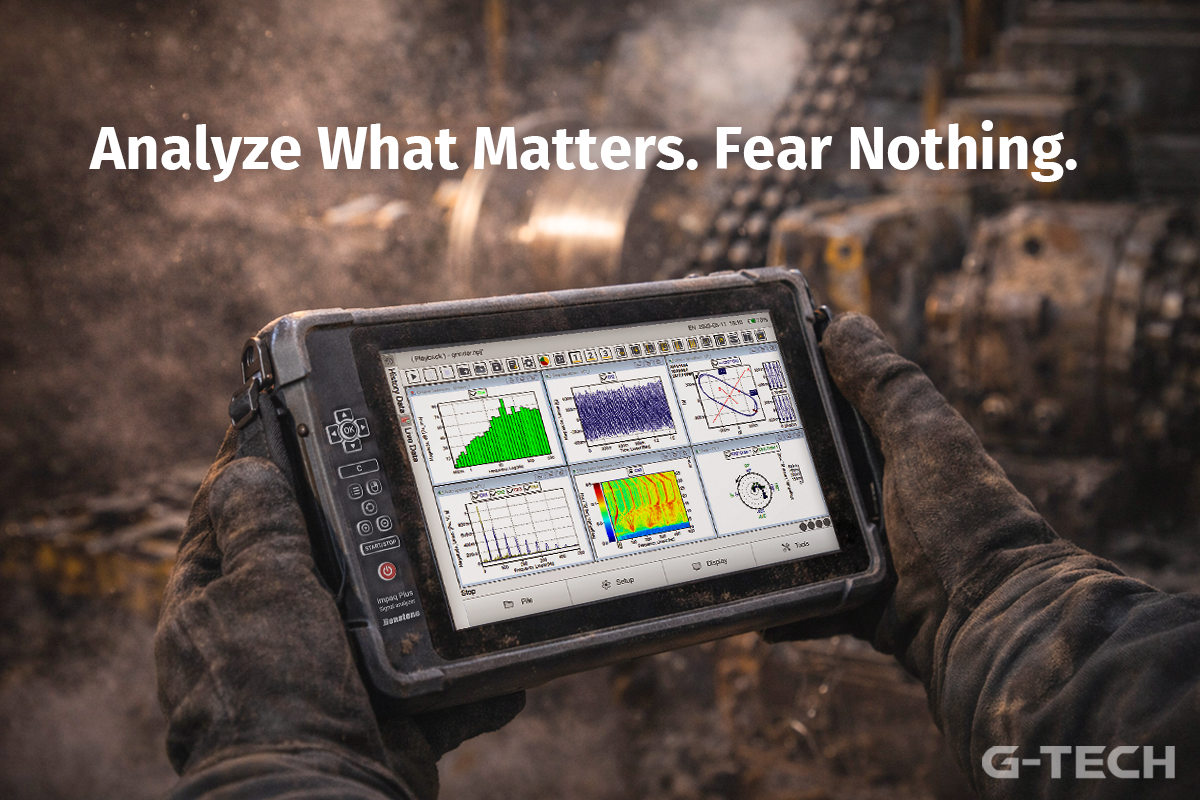
At G-TECH, we focus on designing predictive maintenance tools and data acquisition systems that excel in data collection, analysis, and display. A good example of this is our impaq Plus. This is a vibration analyzer with an intuitive user interface.
It has a comprehensive menu of features or apps, including:
- Dynamic Signal Analysis (DSA)
- FFT Spectrum Analysis
- Envelope Analysis
- Octave Band Analysis
- Order Tracking
- Operational Deflection Shape (ODS) Test
- Orbit Test
- Coast Down Test
- Balancer
- Bump Test
- Data Recorder
- Data Transmission
- Utility Tools
The machine features a large 10.1-inch multi-touch color display that makes visualization and navigation intuitive, smooth, and natural. This clear visualization helps you to detect issues early and act decisively and confidently to prevent machine failure. To learn more about the impaq Plus and other data acquisition devices, check out our product page.