IEPE Amplifiers | G-TECH Instruments Inc.
IEPE amplifiers are crucial devices in the high-tech industry. Without them, it would be impossible to provide power for IEPE devices such as accelerometers, microphones, force, and other dynamic sensors, such as vibration monitoring sensors.
As a result, they are essential in any predictive maintenance strategy. IEPE stands for Integrated Electronics Piezo-Electric. It describes the technical standard for piezoelectric sensors that contain built-in impedance conversion electronics. Such sensors have a range of applications in predictive maintenance and are typically used to measure acceleration, force, and pressure.
IEPE sensor amplifiers include an internal circuit board, and they enable amplification and signal conditioning for piezoelectric charge signals. In this article, we provide a brief explanation of IEPE technology and its importance, and we also look at G-TECH's own IEPE signal amplifier: the GT-3514 4-Channel IEPE Power Supply.
What Is IEPE?
Integrated Electronics Piezoelectric (IEPE) describes a type of transducer that comes with a built-in amplifier included. IEPEs are necessary because of the small charge produced by certain types of sensors. In addition, the electronic signal that is emitted by the transducer can be easily disrupted by noise. This means that highly specialized electronics are required to amplify and condition this signal.
The role of the IEPE sensor is two-fold. It has to make the transducer immune to noise susceptibility as much as possible, and it has to optimize the packaging. It does so by optimizing the integration of the sensitive electronics as close as possible to the transducer. These types of sensors require a current excitation of 4-20 mA to operate.
There is also another type of transducer known as a charge mode sensor. This is a piezoelectric transducer that requires an amplifier. However, the difference with the IEPE transducer is that this type of amplifier exists separately and is not built in. There are several advantages to this arrangement, where the transducer and amplifier are separated.
Namely, it makes it possible to integrate more complicated amplifiers and filters, as well as the ability to operate under higher temperature ranges. This is because this arrangement means fewer constraints or limitations on physical space and power. While these sensors don’t require any external excitation, they can only work on a device that has charge mode amplification.
The importance of IEPE Signal Amplifiers
IEPE sensors have a number of advantages. Its biggest benefit is that they allow the implementation of signal conditioning within many specialized types of software and hardware, including:
- Data Acquisition (DAQ)
- Vibration controller,
- and other acquisition hardware.
The measurement chain is simplified when In-built IEPE power allows sensors to be directly connected to the DAQ and eliminates the need for external charge amplifiers. However, there are many instances where hardware used in measurement instrumentation lacks IEPE signal conditioning capabilities.
This means that there is a need for an external provision of this supply. Preferably, this external provision should be capable of fine-tuning signal gain. G-TECH’s signal amplifiers allow users to drive signals along much longer cables without suffering typical signal distortion at higher frequencies.
G-TECH's IEPE Sensors
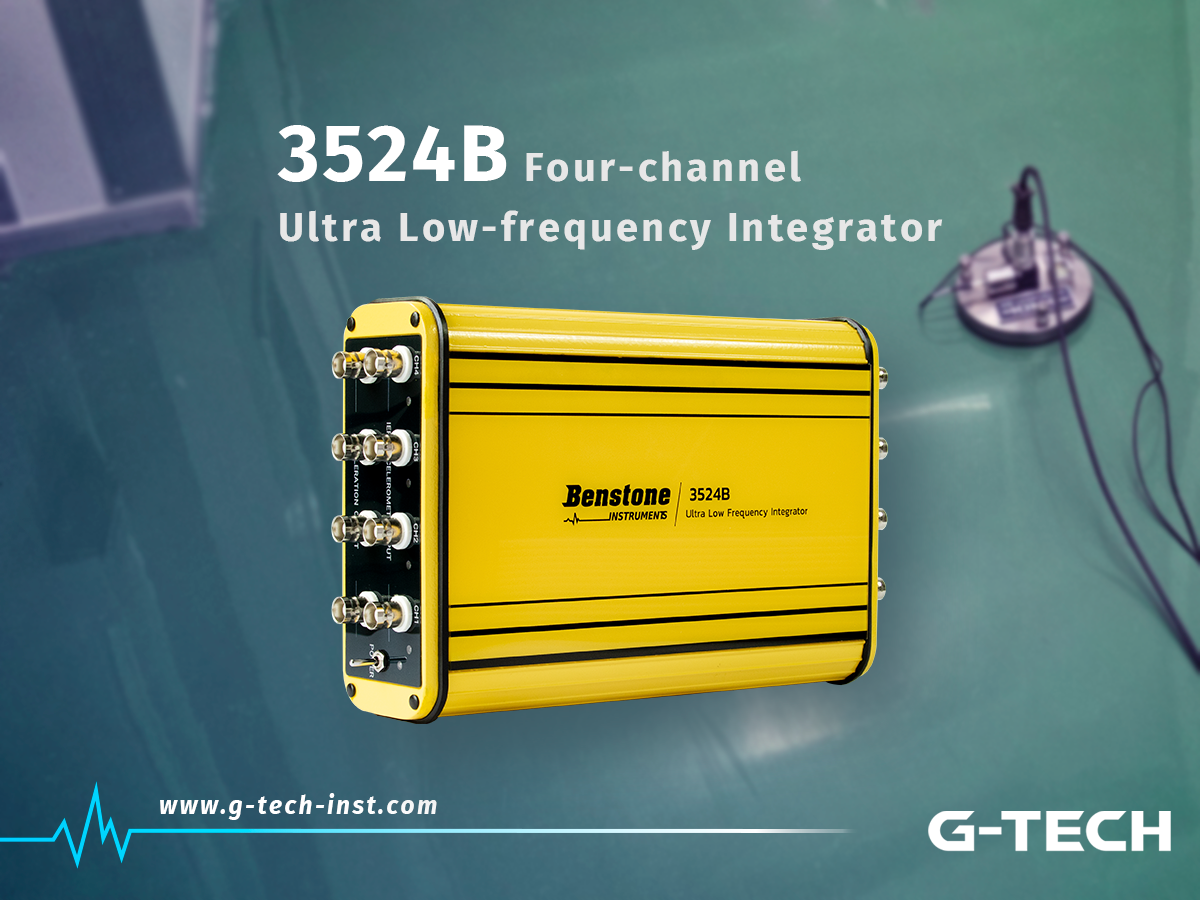
Take our 3524B Four-channel Low-frequency Divider. It is a high-precision, ultra-low-frequency integrating amplifier with a built-in IEPE power supply that easily facilitates the connection of different types of IEPE sensors. It is just the right amplifier for a range of modern industrial functions and contexts, including microvibration measurements and long-term monitoring in:
- High-tech factories
- Large structures and bridges
- Comfort measurement of transport vehicles
In addition to the 3524B, we also have the GT-3514 4-Channel IEPE Power Supply. It provides IEPE-type power supply for a range of devices, such as:
- Accelerometers
- Microphones
- Force meters
- and other sensors
It also provides signal conversion and amplification functions. The GT-3514 can be used in several applications:
- Modal and operational vibration measurement
- Vehicle comfort measurement
- Floor micro vibration and stiffness measurement
- Vibration online monitoring
- Low-frequency vibration measurement of bridges and buildings
- Slope and landslide monitoring
- Semiconductor robot arm monitoring
To learn more about the available G-TECH amplifiers, check out our product page for signal amplifiers.