IoT and Predictive Maintenance
At G-TECH, we constantly work toward incorporating IoT or Internet of Things concepts into the predictive maintenance tools and predictive maintenance software that we manufacture. This is we believe that IoT and Industrial IoT in particular are the future of both modern industry and, by extension, predictive maintenance in this field.
IoT provides the advantage of seamlessly gathering, transferring, and analyzing data for even the most complex devices and systems. It also helps to secure data and enable remote monitoring and analysis. When all of these advantages are considered, IoT represents the most complete and comprehensive approach to achieving a successful predictive maintenance strategy.
Most of the instruments and software that we develop and design here at G-TECH are built to make the most of Industry 4.0 concepts. In fact, one of our mottos is "Smart Solutions for Industry 4.0". It is not just a slogan. It is something we strive toward every day with every tool or piece of software that we design or develop.
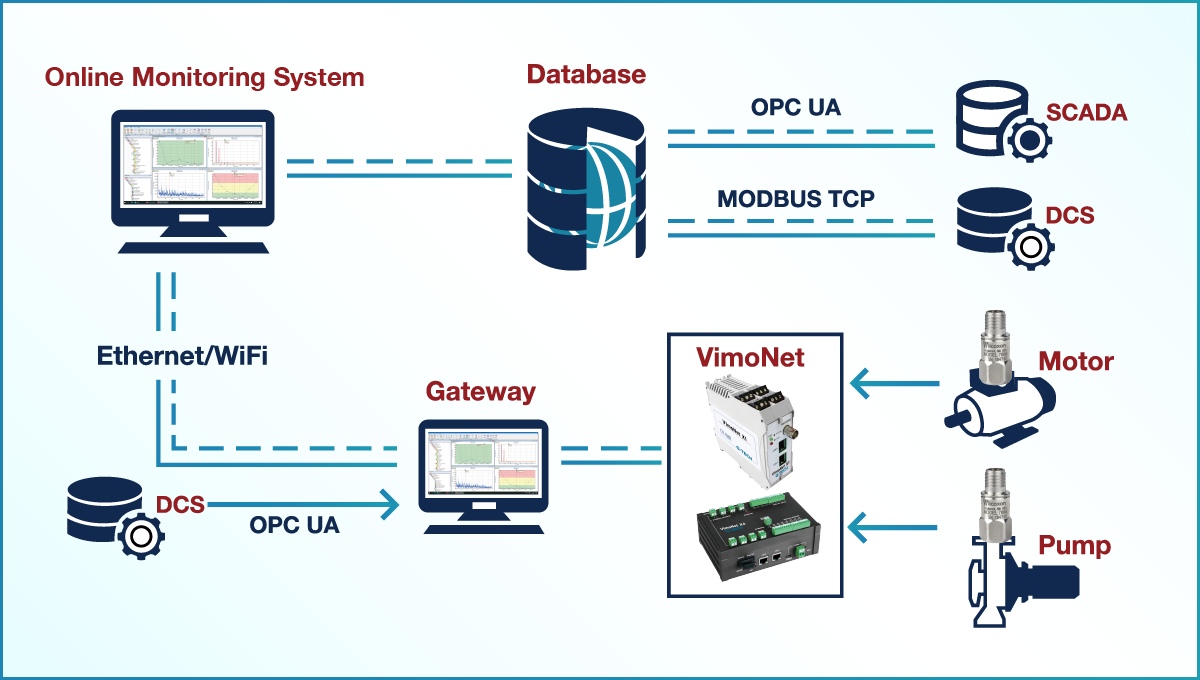
We also focus on building complete systems that connect data with hardware and predictive analytics, such as our Online Monitoring System, illustrated in the diagram below. In this article, we briefly touch upon what IoT means and how we incorporate it into our machines and software.
What Is IoT?
The Internet of Things (or IoT) describes a network made up of physical devices, appliances, and other objects that communicate with each other via sensors that are embedded into them. Such communication is further enabled by software and connectivity through wireless Internet and other types of networks.
IoT devices can also be called smart devices, and in the domestic sphere, they can include things like smartwatches, home alarm systems, and thermostats. In modern industry, it can mean complicated robotic systems, transportation systems, and other sophisticated industrial machinery.
With IoT, smart devices are able to talk with each other, as well as with other devices that rely on the Internet. A massive network of several interconnected devices exchanging data in real-time has a number of far-reaching implications both for everyday modern life and modern industrial applications. It also means several tasks, which presented challenges before the rise of IoT, can now be performed easily:
- Monitoring conditions in industrial environments
- Managing traffic patterns with smart cars and other smart automotive devices
- Remotely controlling robotics and factory machinery
- Monitoring environmental conditions on farms
- Managing and tracking warehouse inventory
The potential for IoT in predictive maintenance is vast. Predictive maintenance typically involves industrial applications in harsh and dynamic field conditions, which may include extremes in temperature, noise, and vibration levels, as well as complicated technological processes.
It is often difficult and dangerous to monitor these conditions in person. Also, the data required to properly monitor these processes is vast and sensitive to detect. IoT technology allows this data to be collected through sensors without endangering human safety while making it convenient to do so remotely. It also means that this data is analyzed in real time to identify deviations from established healthy trends, helping businesses to avoid costly breakdowns and to optimize all their lines of operations.
The Benefits and Growing Importance of IoT
IoT is being recognized by industry leaders in all fields in terms of its importance. For example, a survey by Deloitte has claimed that about 86% of manufacturing executives believe that smart factory solutions will be the main factor behind competitiveness in the coming five years. So IoT is seen as relevant for good reason. Incorporating IoT in both industrial operations and predictive maintenance comes with so many benefits. These include:
- Reduced Maintenance cost
- Increased asset lifetime
- Increased staff efficiency
- Reducing or eliminating unplanned downtime
- Improving staff safety
IoT reduces maintenance costs and increases asset lifetime by catching machine faults before they turn into work stoppages or machine failures. Obviously, a stitch in time saves nine. It might be a cliché, but it’s a cliché that is actually true. By catching these faults early, repairs or replacement of faulty components can be carried out before a disaster that causes unplanned work stoppages occurs.
Business costs are further reduced through increased asset lifetime. Timely repairs mean that machinery lasts longer, and you can avoid the expense of replacing broken machinery. IoT also means that you increase staff efficiency. Your engineers and technical staff can more easily collect and interpret data, saving a huge amount of time.
At G-TECH, we take pride in using IoT while blending sophisticated analysis with easy-to-read interfaces in our predictive maintenance tools. This means that even the most junior engineering staff will find it easy to collect and interpret data, which would also increase your technical efficiency.
Lastly, the incorporation of IoT in predictive maintenance makes it easy to avoid unplanned downtimes, which is the ultimate goal of an effective predictive maintenance strategy. This helps reduce costs and avoid order delays and cancellations. Machine failure can also be a hazard to worker safety and health. A predictive maintenance culture that incorporates IoT can help avoid such hazards.
How G-TECH Incorporates IoT in Predictive Maintenance
G-TECH provides a range of software, devices, and hardware that make up the component parts of IoT technology. These include the following:
- Sensors
- Data communication
- Predictive analytics hardware
- Predictive analytics software
1. Sensors. Sensors, such as vibration monitoring sensors, enable data to be collected in real time from various devices and locations. This data allows businesses to make decisions on an informed basis and in a timely manner. Check out this page for more info on G-TECH sensors.
2. Predictive analytic hardware. To collect data, besides sensors, you require hardware such as handheld vibration analyzers or PC-based vibration analyzers like G-TECH’s Novian. AT G-TECH, our vibration analyzers are tough, reliable, easy-to-use, and comprehensive in their data collection and analysis capabilities.
3. Data communication. This refers to transferring data between devices. It can be used either in connection with a cloud or through edge computing. In any event, it allows for data to be collected and analyzed remotely. G-TECH hardware, such as vibrometers like the vPod Pro allows for local storage of data.
4. Predictive analytics. This is an analytical tool that makes sure you stay ahead of equipment failures. It can identify potential issues before they become major problems, which means you can save both time and money. Combining data collected through vibration analyzers and other hardware with predictive maintenance software is the most effective way to carry out predictive maintenance. This is why we make sure that most of our hardware can work in conjunction with software systems such as our predictive maintenance software.
At G-TECH, we are committed to delivering Industry 4.0-based solutions to the problems of predictive maintenance. We do so by designing tools and software that prioritize the incorporation of IoT concepts and technology, while emphasizing convenience and intuitive interfaces and design. To learn more, check out our top products on our homepage.